
Sewage Holding Tank Size Calculation for STP
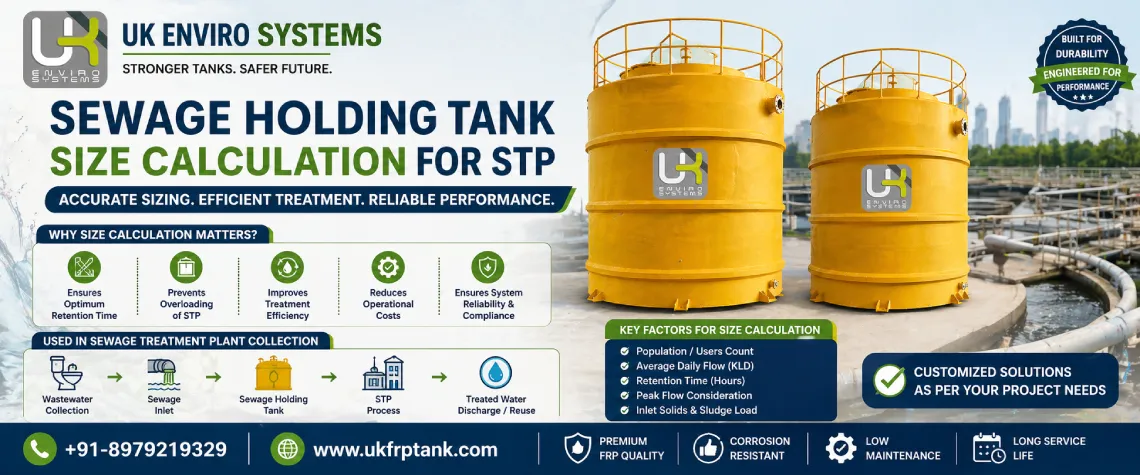
Proper sizing of a sewage holding tank is critical. Many engineers struggle with this task. You need accurate calculations for a functional STP. STP Collection Tank Manufacturers provide essential guidance for this process. This blog explains the exact method for tank sizing. You will learn simple formulas and practical steps.
Understanding Sewage Holding Tanks
A sewage holding tank stores wastewater temporarily. It feeds the treatment plant at a steady rate. Without proper sizing, the system fails. Overflow or underflow creates serious problems. Sewage Treatment Plant Collection Tanks must match the inflow patterns. They also need enough volume for peak loads.
Holding tanks come in various shapes. Round and rectangular designs are common. Underground installation saves space. Above-ground tanks offer easier maintenance. STP Tanks often work as primary settling units. They remove large solids before biological treatment.
Why Correct Sizing Matters
Oversized tanks waste money. They take up unnecessary space. Undersized tanks cause frequent overflows. This leads to environmental violations. Underground Sewage Tanks need exact volume calculations. Otherwise, soil contamination occurs. Correct sizing also reduces pumping costs. It balances the whole Wastewater Management System.
Key Factors for Tank Sizing
Several parameters influence tank volume. You must collect accurate data first. Here are the main factors:
- Daily wastewater flow rate
- Peak hourly flow rate
- Retention time required
- Sludge accumulation rate
- Temperature and climate conditions
Sludge Collection Tanks require additional volume. Sludge settles at the bottom. This space does not hold liquid. Always add 20-30% extra for sludge. FRP Water Storage Tanks can handle these conditions well.
Daily Flow Estimation
Start with the number of users. Each person produces 100-150 liters per day. Commercial buildings need higher estimates. Hospitals produce 400-600 liters per bed. Hotels produce 200-300 liters per guest. Schools produce 50-80 liters per student. Multiply the user count by per capita flow. This gives daily average flow.
For example, a factory with 500 workers. Each worker uses 70 liters daily. Total flow equals 35,000 liters per day. That is 35 cubic meters. STP Collection Tank Manufacturers recommend using this base number.
Peak Flow Factor
Daily average is not enough. Peaks occur during morning and evening. Use a peak factor of 2 to 4. Smaller systems need higher factors. A 35 m³/day system uses factor 3. Peak flow becomes 105 m³/day. Your tank must handle this surge. Otherwise, raw sewage bypasses treatment. Sewage Treatment Plant Collection Tanks must absorb these peaks.
The Calculation Formula
Basic formula for tank volume: V = (Q × t) + Vs + Vf
Where:
- V = Total tank volume (cubic meters)
- Q = Flow rate (cubic meters per hour)
- t = Retention time (hours)
- Vs = Sludge volume (cubic meters)
- Vf = Freeboard volume (cubic meters)
Standard retention time is 12 to 24 hours. Longer retention improves settling. But it increases tank size. STP Tanks often use 18 hours as a balanced choice.
Step-by-Step Calculation
Let us calculate for a residential complex. The complex has 200 apartments. Each apartment has 4 people. Total population is 800 persons. Per capita flow is 120 liters per day. Daily flow equals 800 × 120 = 96,000 liters. That is 96 m³ per day.
Peak flow factor for this size is 2.5. Peak hourly flow equals 96 × 2.5 / 24 = 10 m³ per hour. Retention time is 18 hours. Liquid volume needed = 10 × 18 = 180 m³.
Now add sludge volume. Sludge accumulates at 0.05 m³ per person per year. Cleaning interval is 2 years. Total sludge = 800 × 0.05 × 2 = 80 m³. Sludge Collection Tanks require this extra space.
Freeboard is 0.5 meters. For a rectangular tank of 10m × 6m area, freeboard volume = 10 × 6 × 0.5 = 30 m³. Total tank volume = 180 + 80 + 30 = 290 m³. Underground Sewage Tanks of this size serve the complex well.
Role of Quality Manufacturers
Always choose reliable STP Collection Tank Manufacturers. They provide custom sizing services. Poor manufacturing leads to leaks and cracks. Quality manufacturers use premium materials. They also offer installation support. FRP Water Storage Tanks from trusted sources last 20+ years.
Why FRP is Preferred
Fiber Reinforced Plastic (FRP) offers many benefits. It resists corrosion completely. Steel tanks rust over time. Concrete tanks crack and leak. Chemical Storage Tanks made of FRP handle harsh wastewater. The same material works for Acid Storage Tanks and Sewage Treatment Plant Collection Tanks.
FRP is lightweight yet strong. Installation takes less time. Maintenance costs remain low. The smooth inner surface prevents bacterial growth. Cleaning becomes easier. Many industries now switch to FRP. Wastewater Management System designers recommend FRP for long-term reliability.
Materials and Tank Types
Besides FRP, other materials exist. Each has pros and cons.
- Polyethylene Tanks: These are affordable and light. However, they lack structural strength. Large sizes require metal supports. UV light degrades the plastic. Use only for small STP Tanks.
- Concrete Tanks: Concrete is heavy but durable. It works well for Underground Sewage Tanks. But concrete cracks under ground movement. Repairs are costly and difficult. Sealing joints becomes a constant challenge.
- Steel Tanks: Carbon steel tanks need protective coatings. Coatings fail over time. Rust leads to holes and leaks. Stainless steel costs much more. Acid Storage Tanks use special grades. For sewage, FRP remains superior.
- Modular Tanks: Some STP Collection Tank Manufacturers offer modular designs. These bolt together on site. They suit remote locations. Transportation is easier than one large tank. Cleaning and access are also simpler.
Installation Considerations
Proper installation prevents future failures. Follow these guidelines:
- Excavate a stable foundation bed.
- Add a sand or gravel layer for leveling.
- Place the tank carefully without damage.
- Backfill with compacted soil gradually.
- Install inlet and outlet pipes with proper slope.
- Add ventilation to release harmful gases.
Underground Sewage Tanks need anti-flotation measures. Groundwater can lift empty tanks. Concrete anchors or heavy holds prevent this. Sewage Treatment Plant Collection Tanks must stay firmly in place.
Inlet and Outlet Design
The inlet pipe enters above the sludge zone. A tee fitting directs flow downward. This reduces turbulence. The outlet pipe draws from the clear zone. A baffle prevents floating solids from escaping. STP Tanks with good hydraulics improve treatment efficiency.
Maintenance and Sludge Management
Regular cleaning keeps your tank functional. Sludge accumulates over months. Measure sludge depth annually. Remove sludge when it reaches one-third of liquid depth. Sludge Collection Tanks need efficient removal systems.
Vacuum trucks pump out accumulated sludge. Never discharge sludge directly into drains. Treat it properly or send to a central facility. Wastewater Management System operators schedule cleaning cycles. Ignoring sludge reduces tank capacity. Eventually, solids carry over to downstream units.
Monitoring Performance
Check for these warning signs:
- Foul odors near the tank
- Slow drainage from buildings
- Frequent pump activations
- Visible solids in outlet flow
Early detection saves repair costs. FRP Storage Tanks allow easy inspection ports. Use these ports for regular sampling. Chemical Storage Tanks have similar access features. Apply the same inspection discipline to sewage tanks.
Sizing Example for Industrial Use
Consider a food processing plant. The plant produces 500 m³ of wastewater daily. Flow is continuous over 16 hours. Peak hourly flow is 40 m³. Retention time is 12 hours. Liquid volume = 40 × 12 = 480 m³.
Sludge production is high due to organic solids. Estimate 0.2 m³ per 100 m³ flow. Daily sludge = 500 × 0.002 = 1 m³. Cleaning every 90 days gives 90 m³ sludge. Freeboard adds 50 m³. Total volume = 480 + 90 + 50 = 620 m³.
STP Collection Tank Manufacturers can fabricate this size. Two rectangular tanks of 310 m³ each work well. This allows one tank offline for cleaning. Underground Sewage Tanks of this size require careful design. Groundwater pressure becomes significant.
Common Mistakes to Avoid
Many designers make these errors:
- Using average flow only, ignoring peaks
- Forgetting sludge accumulation space
- Choosing wrong retention time
- Neglecting freeboard for waves
- Installing without anti-flotation anchors
Sewage Treatment Plant Collection Tanks fail because of these oversights. Always verify your assumptions. Ask a second engineer to review calculations. Acid Storage Tanks need similar caution. The same principles apply across different liquids.
Freeboard Importance
Freeboard is the empty space above liquid. It prevents spillage during surges. Wind can create waves in large tanks. Freeboard also stops floating solids from escaping. Minimum freeboard is 300 mm. For STP Tanks over 100 m³, use 500 mm.
Using Software Tools
Manual calculations work for simple cases. Complex projects need software. Many STP Collection Tank Manufacturers provide sizing programs. These tools account for variable flows. They simulate different retention times. Some even calculate sludge digestion. But always verify software outputs with hand calculations.
Record Keeping
Document every sizing decision. Keep flow data, peak factors, and sludge estimates. This helps during future expansions. Wastewater Management System upgrades become easier with good records. FRP Water Storage Tanks also benefit from documented sizing logs.
Conclusion
Accurate sewage holding tank size calculation ensures STP success. Start with daily flow and peak factors. Apply retention time for liquid volume. Add sludge accumulation and freeboard. Choose reliable STP Collection Tank Manufacturers for fabrication. Sewage Treatment Plant Collection Tanks made of FRP offer the best durability. Whether you need Underground Sewage Tanks, Sludge Collection Tanks, or Chemical Storage Tanks, the math remains similar. Use the formula V = (Q × t) + Vs + Vf every time. Check your work with practical examples. Maintain regular cleaning schedules. Consequently, your Wastewater Management System will run smoothly for decades. Proper sizing also reduces energy use and extends equipment life. Always prioritize quality materials and professional installation. In short, master the calculation once, and your STP will serve reliably year after year.