
Complete Guide to PP FRP Tanks for STP Applications
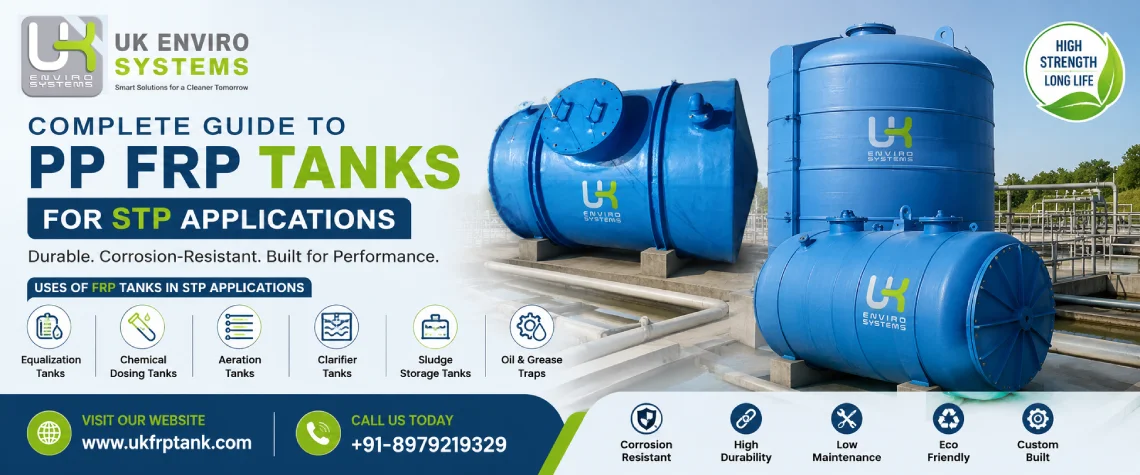
PP FRP STP Tanks in Ghaziabad
Industrial facilities face constant pressure. They need safe operations and high output. FRP Industrial Storage Tanks solve both challenges. These tanks store aggressive chemicals, water, and fuels. They prevent leaks and spills. They also reduce maintenance downtime. This blog explains the technical benefits. You will learn how Storage Tanks boost plant safety and efficiency.
Understanding PP FRP Composite Technology
PP FRP combines two powerful materials. Polypropylene (PP) forms the inner liner. Fiber Reinforced Plastic (FRP) creates the outer structural layer. This composite offers unique benefits for sewage treatment.
Material Composition and Properties
The PP liner resists chemical attack. Sewage contains acids, alkalis, and organic compounds. PP withstands these harsh substances perfectly. The liner thickness typically ranges from 3mm to 6mm. This depends on tank size and operating conditions.
FRP outer layer provides mechanical strength. Engineers use isophthalic or vinyl ester resins. Glass fiber reinforcements add tensile strength. The result is a tank that handles high loads. It also resists environmental degradation.
Why PP Liner with FRP Outer Layer?
PP alone lacks structural rigidity. FRP alone cannot resist certain sewage chemicals. Together, they solve both problems. The PP liner prevents corrosion from within. The FRP shell protects against external forces. This synergy creates long-lasting PP FRP Tanks for STP.
Key Advantages for Sewage Treatment Plants
STP operators face many challenges. Corrosion, leakage, and maintenance top the list. PP FRP STP Tanks address these issues effectively.
Chemical Resistance Against Sewage Corrosion
Raw sewage contains hydrogen sulfide. This gas forms sulfuric acid through bacterial action. Acid attacks concrete and metal tanks quickly. PP FRP tanks resist this acid completely. The PP liner shows no degradation after years of exposure. Even high chloride levels cause no pitting or cracking.
Structural Integrity Under Variable Loads
STPs experience fluctuating fill levels. Empty tanks face soil pressure from outside. Full tanks face hydrostatic pressure from inside. PP FRP construction handles both scenarios. The FRP laminate distributes stress evenly. Cracking or buckling rarely occurs.
Lightweight Nature Reduces Installation Costs
Concrete tanks require heavy lifting equipment. Steel tanks need cranes for positioning. PP FRP Storage Tank for Sewage Treatment Plant weighs 80% less than concrete. Three workers can move a small tank. Large tanks need minimal support structures. This reduces foundation costs significantly.
Technical Specifications of PP FRP Tanks
Every STP application demands precise engineering. UK Enviro Systems follows strict specifications. These ensure optimal performance for decades.
Wall Thickness and Laminate Schedule
The laminate schedule determines tank strength. A typical schedule includes three layers. The inner PP liner measures 4mm minimum. The intermediate chopped strand mat layer adds 3mm. The outer woven roving layer provides 5mm. Total wall thickness exceeds 12mm for large tanks. Smaller tanks use proportionally thinner walls.
Temperature and Pressure Ratings
PP FRP Tanks for STP operate from 0°C to 60°C. The PP liner softens above 80°C. Standard design pressure is atmospheric. Vacuum service requires additional stiffening rings. Positive pressure up to 0.5 bar needs thicker laminates. Always specify operating conditions during ordering.
Dimension Ranges and Capacities
Standard diameters range from 1 meter to 4 meters. Heights reach up to 5 meters. Capacities span from 1000 liters to 50,000 liters. Custom sizes are available for special projects. Rectangular shapes suit limited spaces. Cylindrical shapes offer best strength-to-weight ratios.
Design Considerations for STP Applications
Proper design ensures trouble-free operation. Engineers must evaluate several factors before selection. These include flow rates, chemical loads, and site conditions.
Hydraulic Retention Time Optimization
STP efficiency depends on retention time. PP FRP STP Tanks allow precise volume calculations. For primary clarifiers, retention time of 2 to 4 hours works well. Equalization tanks need 8 to 12 hours. The tank dimensions directly affect these parameters. Always calculate volume based on peak flow rates.
Customized Configurations for Flow Rates
Inlet and outlet positions matter greatly. Standard configurations include center inlet and side outlet. Baffles improve flow patterns inside the tank. Without baffles, short-circuiting reduces treatment efficiency. PP FRP Tank for STP can include internal baffle walls. These are bonded during manufacturing.
Nozzle and Flange Specifications
Every tank needs nozzles for piping connections. Standard nozzle sizes include 80mm, 150mm, and 200mm. Flanges follow DIN or ANSI standards. Threaded connections suit small tanks. Flanged connections work better for large diameters. Specify nozzle locations on the tank drawing.
Installation and Integration with STP Infrastructure
Correct installation extends tank life significantly. Sewage Treatment Plant Equipment requires careful handling. Follow these guidelines for best results.
Foundation Requirements
Tanks need flat, level foundations. Concrete pads with steel reinforcement work best. The foundation must support full water weight. For a 10,000-liter tank, this equals 10 metric tons. Soil bearing capacity must exceed this value. Sand or gravel beds are not acceptable for large tanks.
Lifting and Positioning Methods
Use spreader beams during lifting. Never lift from a single point. Four lifting lugs work best for cylindrical tanks. Protect the PP liner from impact damage. Drop the tank gently onto rubber pads. These pads compensate for minor foundation irregularities.
Piping Connections and Flexibility
Connect pipes using flexible couplings. Rigid connections cause stress cracking. The tank settles slightly after filling. Flexible joints accommodate this movement. Install isolation valves near each nozzle. This allows maintenance without draining the tank.
Maintenance and Longevity Practices
PP FRP tanks require minimal maintenance. But some practices extend service life beyond 25 years. Follow these recommendations for your STP Infrastructure Equipment.
Inspection Protocols
Perform visual inspections every three months. Check for surface cracks or blisters. The PP liner should remain smooth and glossy. FRP outer layer may show minor scratches. Deep scratches need immediate repair. Use a moisture meter to detect hidden delamination.
Cleaning Procedures for PP Liner
Sewage leaves organic deposits on tank walls. Clean the tank annually. Use high-pressure water jets below 100 bar. Never use metal scrapers or steel wool. Soft nylon brushes remove stubborn deposits. Chemical cleaning uses mild detergents only. Avoid strong solvents that attack PP.
Repair Techniques for Minor Damages
Small cracks in FRP require simple repairs. Grind the damaged area to a 45-degree angle. Apply fresh resin and glass fiber mat. Cure for 24 hours before service. PP liner cracks need hot gas welding. Use a PP welding rod and extrusion gun. Test the repair with a spark tester.
Role of PP FRP Tanks in STP Chemical Dosing
Chemical dosing improves sewage treatment efficiency. STP Chemical Dosing Tanks require special materials. PP FRP meets these requirements perfectly.
Compatibility with Coagulants and Flocculants
Alum and ferric chloride are common coagulants. These chemicals corrode mild steel rapidly. PP FRP shows no reaction with either chemical. Polymer flocculants have neutral pH values. But they often contain organic solvents. The PP liner resists solvent attack effectively.
Dosing Tank Design Features
Chemical dosing tanks need conical bottoms. This ensures complete draining. Flat bottoms leave residue that crystallizes. A 60-degree cone angle works for most chemicals. Tank agitation requires vertical baffles. These prevent vortex formation during mixing.
Safety Measures for Chemical Storage
Secondary containment is mandatory for hazardous chemicals. Place the PP FRP tank inside a concrete dike. The dike must hold 110% of tank volume. Install a level sensor with high alarm. Provide eyewash stations nearby. Always label the tank with chemical name and hazards.
Comparing PP FRP with Conventional Materials
Understanding material differences helps selection. PP FRP Tanks for STP outperform many alternatives. Here is a technical comparison.
Versus Mild Steel Tanks
Mild steel corrodes rapidly in sewage. Protective coatings fail within five years. Steel tanks need cathodic protection systems. These add cost and complexity. PP FRP tanks need no coatings or protection. The material itself resists corrosion. Initial cost of PP FRP is higher. But lifecycle cost is 40% lower.
Versus Concrete Tanks
Concrete suffers from acid attack. Sewage pH often drops below 5. This dissolves cement paste gradually. Concrete tanks also crack from ground movement. Repairing concrete cracks is expensive. PP FRP tanks flex without cracking. Installation time is weeks versus months. And PP FRP tanks are fully removable.
Versus Stainless Steel
Stainless steel resists general corrosion. But crevice corrosion occurs at welds. Chlorides in sewage cause pitting. Grade 316L stainless steel still shows attack. PP FRP has no metal content. Therefore, no galvanic or pitting corrosion occurs. The cost difference favors PP FRP for most STPs.
Quality Assurance and Standards
UK Enviro Systems follows rigorous quality protocols. Every PP FRP Storage Tanks for Sewage Treatment Plant meets international standards. These include ISO 9001 for manufacturing. Also ASTM D3299 for filament wound tanks. Pressure tests verify structural integrity. Each tank holds test pressure for 24 hours. No leakage or sweating is acceptable.
Future Trends in Sewage Treatment Plant Equipment
The industry moves toward sustainable materials. Sewage Treatment Plant Equipment must reduce carbon footprints. PP FRP tanks already support this goal. They last longer than conventional tanks. They require less energy to manufacture. Future developments include bio-based resins. Recycled PP liners are under development. UK Enviro Systems leads these innovations.
Final Technical Recommendations
Select PP FRP STP Tanks in Ghaziabad for reliable service. Always verify chemical compatibility before ordering. Provide complete operating conditions to the manufacturer. Include temperature ranges and pH extremes. Specify any vacuum or pressure requirements. Request a detailed laminate schedule. Inspect the tank upon delivery for damage. Install on proper foundations with flexible piping. Perform regular inspections as described. Follow these guidelines for 25+ years of service. UK Enviro Systems supports your STP with premium quality tanks. Contact our technical team for custom designs.