
Why Do HCl Storage Tank Manholes Leak? How FRP Solves It
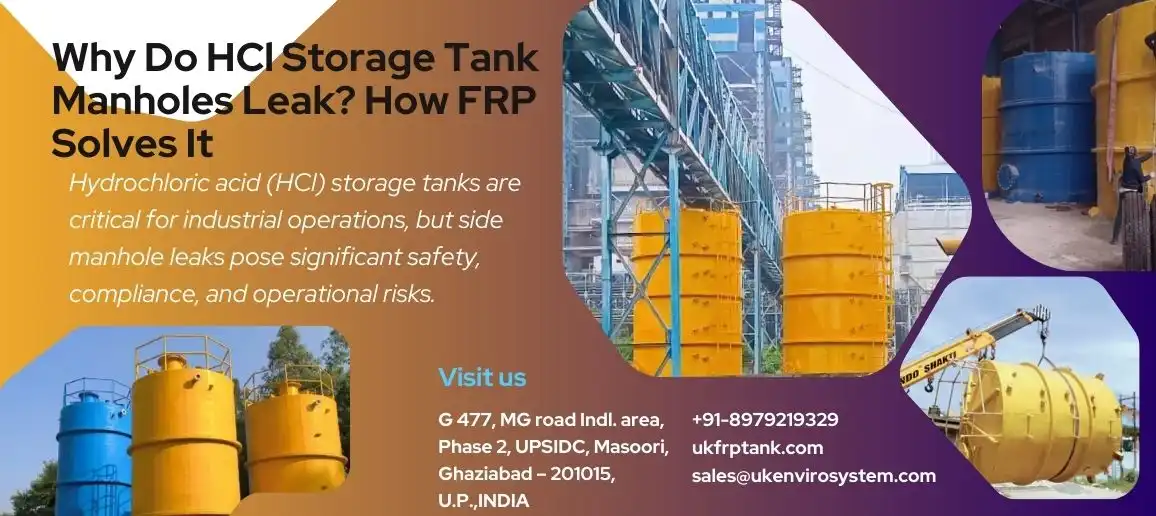
For industrial operations, a leaking HCl storage tank manhole is more than a nuisance; it’s a critical failure that halts production and endangers personnel. The problem lies in the ‘side’ location, where constant hydrostatic pressure, direct acid exposure, and vertical sealing challenges conspire to defeat standard tanks. However, this engineering puzzle has a definitive solution. Leading HCl Storage Tanks Manufacturers utilize advanced FRP technology to master these unique stressors, ensuring safety and efficiency in even the most demanding chemical environments.
Why Do HCl Storage Tank Side Manholes Leak?
Corrosion from Direct HCl Exposure: Side manholes often sit closer to the liquid level, exposing them to concentrated HCl. Traditional metal tanks corrode faster in these zones, leading to pitting, cracks, and eventual leakage.
Hydrostatic Pressure & Mechanical Stress: The weight of stored HCl exerts constant hydrostatic pressure on side manholes. Metal tanks flex under this stress, fatiguing seals and joints over time. This pressure-stress cycle weakens structural integrity, causing leaks.
Vertical Sealing Challenges: Unlike top manholes, side manholes are vertically oriented. Gravity and pressure can shift gaskets or lids, compromising seals. Inferior gaskets or improper installation accelerate failure, allowing acid or vapors to escape.
Thermal Expansion & Combined Stress: Temperature fluctuations cause tank materials to expand and contract. Side manholes face added stress from both thermal changes and hydrostatic pressure, creating cracks in weak spots like joints.
Substandard Material Selection: Materials not rated for HCl corrosion and mechanical stress (e.g., low-grade metals or thin linings) degrade quickly under the dual assault of chemical exposure and pressure.
How FRP Tanks Solve Side Manhole Leakage
Unmatched Corrosion Resistance: FRP tanks are inherently non-reactive to HCl, even at high concentrations. They resist pitting, rust, and degradation, ensuring longevity in corrosive liquid or vapor zones.
Engineered for Hydrostatic Pressure: FRP’s high strength-to-weight ratio allows manufacturers to reinforce side manholes with thicker laminates and structural ribs. This design withstands constant pressure without flexing or fatigue.
Vertical Seal Optimization: FRP manholes are designed with vertical sealing in mind:
Compression-resistant gaskets (PTFE or EPDM) maintain seal integrity under pressure.
Bolted flanges with even load distribution prevent lid shifting.
Double-seal systems combine primary and backup gaskets for leak-proof performance.
Thermal Stability & Crack Resistance: FRP’s low thermal expansion coefficient minimizes stress from temperature swings. The material’s flexibility prevents cracks, even under combined thermal and mechanical stress.
Customizable for Pressure and Chemistry: As leading HCl Storage Tank Manufacturers, we tailor FRP tanks to your specific needs:
Adjust wall thickness and reinforcement around side manholes.
Optimize resin formulations for HCl concentration and operating temperatures.
Steps to Eliminate Side Manhole Leaks with FRP
Assess Pressure and Corrosion Damage: Inspect side manholes for cracks, seal wear, or deformation caused by hydrostatic stress.
Replace Metal Tanks with FRP: Transition to FRP for superior chemical and mechanical resilience. Eliminate recurring repair costs and downtime.
Install Pressure-Rated Seals: Upgrade to gaskets and bolts designed for vertical, high-pressure applications.
Routine FRP Maintenance: Schedule annual inspections to check seals and reinforcement zones. FRP’s durability ensures minimal upkeep.
Why Choose Us as Your HCl Storage Tanks Manufacturer?
Pressure-Optimized Designs: FRP tanks engineered to handle side manhole stress.
ASME/ISO-Compliant Fabrication: Guaranteed safety and performance.
Leak-Proof Warranty: Confidence in every joint and seal.
25+ Years of Expertise: Trusted solutions for aggressive chemicals like HCl.
Conclusion
Side manhole leaks in HCl storage tank stem from unique pressure, corrosion, and sealing challenges. FRP Tanks address these issues head-on with corrosion-resistant materials, pressure-resistant designs, and vertical-seal innovation. As experienced HCl Storage Tanks Manufacturers, we deliver leak-free solutions that protect your operations, budget, and safety.
Upgrade to FRP today—contact us for a custom quote!
FAQ: Everything You Need to Know About FRP Tanks
Side manholes are uniquely susceptible because they are submerged or partially submerged, enduring constant hydrostatic pressure that tests sealing integrity and exposes materials to direct liquid corrosion, unlike top manholes.
Continuous pressure forces the tank wall to flex, compressing and decompressing the gasket. This repeated stress fatigues the gasket material and can unseat bolted connections, creating a path for acid and vapors to escape.
No. Standard rubber degrades from HCl exposure and lacks the compressive strength to maintain a seal under pressure. We recommend specialized, compression-resistant gaskets like PTFE or EPDM for these demanding applications.
Repairs often fail at the heat-affected zone around the weld. The welding process itself alters the metal's structure, creating a new, corrosion-prone weak point that often leads to a new leak shortly after repair.
No. While FRP is far more durable, annual inspections are still crucial to verify seal integrity and check for any stress on structural reinforcements. However, inspections shift from emergency repairs to routine, preventative checks.