
Top Benefits of FRP MBBR Tanks for Wastewater Treatment Plants
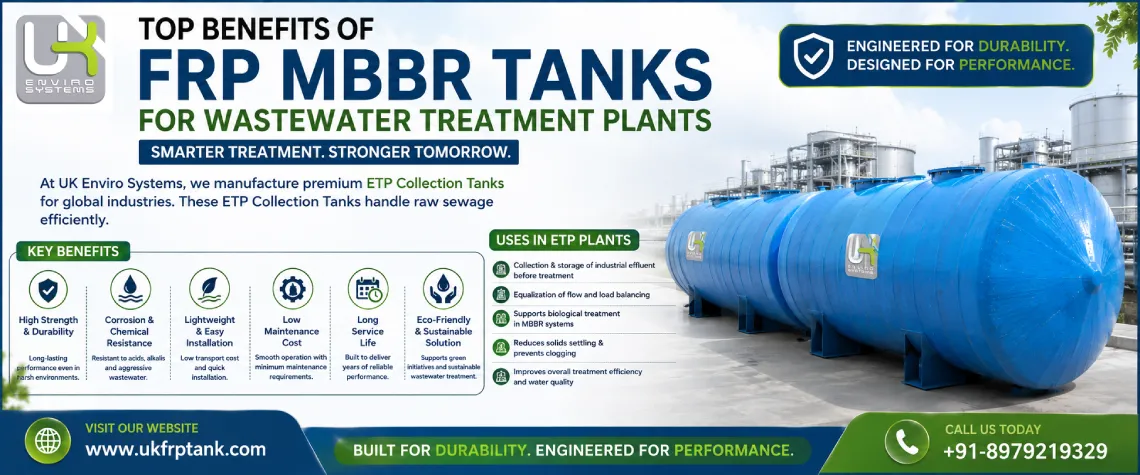
Wastewater treatment demands robust and efficient solutions. Moving Bed Biofilm Reactor (MBBR) technology offers one such solution. When you combine MBBR with FRP construction, you get exceptional performance. As a leading ETP MBBR Tanks Manufacturer, UK Enviro Systems delivers these advanced tanks worldwide. This blog explores the top benefits of FRP MBBR tanks. You will learn why they outperform conventional options.
What Is an FRP MBBR Tank?
An FRP MBBR tank uses fiberglass reinforced plastic as its structural material. Inside, it houses thousands of plastic biofilm carriers. These carriers provide surface area for bacteria. The bacteria break down organic pollutants. Air diffusers keep carriers moving throughout the tank. This movement ensures even distribution of biomass. FRP construction protects the tank from harsh wastewater chemicals.
How MBBR Technology Works
Wastewater enters the tank continuously. Bacteria attach to the carrier surfaces. They form a biofilm layer. This biofilm consumes dissolved organic matter. Aeration supplies oxygen for aerobic digestion. The moving carriers self-clean through abrasion. Excess biofilm sloughs off naturally. Treated water then flows to a settling stage. Finally, you store it in a Treated Water Storage Tank.
Superior Corrosion Resistance
Wastewater contains acids, alkalis, and salts. These substances corrode steel and concrete rapidly. FRP resists almost all chemical attacks. It does not rust or spall. Therefore, FRP MBBR tanks last much longer. You save money on repairs and replacements. This benefit makes every ETP MBBR Tanks Manufacturer recommend FRP for aggressive effluents.
Protection Against Hydrogen Sulfide
Sewage generates hydrogen sulfide gas. This gas forms sulfuric acid in moist conditions. Acid attacks metal and concrete severely. FRP handles this environment effortlessly. Its resin matrix blocks acid penetration. The tank remains structurally intact for decades. Consequently, you avoid unplanned shutdowns.
Lightweight Yet High Strength
FRP weighs only one-fifth of steel. Yet its strength-to-weight ratio exceeds steel. This lightweight nature simplifies transportation. It also reduces foundation requirements. You do not need heavy cranes for installation. Smaller support structures lower civil costs. Additionally, you can install tanks on rooftops. This flexibility benefits space-constrained plants.
Impact Resistance
The glass fibers absorb impact energy. They prevent cracks from physical shocks. This durability proves valuable during maintenance. Workers can walk on the tank top safely. Tools dropped accidentally cause no damage. Thus, operational safety improves significantly.
Long Service Life with Low Maintenance
FRP MBBR tanks require minimal upkeep. Their smooth inner surface resists fouling. Biofilm sloughs off without sticking. You rarely need internal cleaning. External painting is unnecessary. UV-resistant gel coats protect against sunlight. Compare this to steel tanks that need repainting every few years. Over a 20-year lifecycle, FRP saves substantial maintenance costs.
No Cathodic Protection Needed
Steel tanks need sacrificial anodes or impressed current systems. These systems add complexity and expense. FRP does not corrode, so you eliminate cathodic protection. Your maintenance team focuses on core operations. This simplicity appeals to plant managers.
Excellent Thermal Insulation
FRP has low thermal conductivity. It maintains stable internal temperatures. Biological processes perform optimally at consistent temperatures. Fluctuations reduce treatment efficiency. FRP minimizes heat loss in cold climates. It also prevents overheating in hot environments. This insulation reduces energy costs for heating or cooling. Your treated water quality remains steady year-round.
Easy Installation and Customization
FRP tanks come in modular sections. You assemble them quickly on-site. Bolted or bonded joints create leak-proof seals. Installation takes days, not weeks. Moreover, we offer custom sizes and shapes. Need a vertical or horizontal configuration? We build accordingly. Our Customized Treated Water Tank options include multiple inlet and outlet positions. We also integrate internal baffles and aeration grids.
Adaptable to Retrofits
Existing treatment plants often need upgrades. FRP MBBR tanks fit into tight spaces. Their lightweight design allows placement on existing slabs. You can add them without major civil works. This adaptability makes them ideal for capacity expansions. Many STP Water Tank Manufacturer in India recommend FRP for retrofits.
Excellent Biofilm Carrier Compatibility
MBBR carriers require specific hydraulic conditions. FRP tanks provide smooth internal surfaces. This smoothness prevents carrier abrasion. Carriers maintain their shape for years. Consistent carrier movement ensures even biofilm growth. Consequently, treatment efficiency remains high. The tank geometry optimizes carrier fluidization. We design our tanks based on computational fluid dynamics. This engineering guarantees proper mixing and aeration.
High Organic Loading Tolerance
MBBR systems handle shock loads effectively. FRP tanks withstand the associated hydraulic surges. Their structural strength accommodates fluctuating flow rates. You can treat high-strength industrial effluents confidently. Petrochemical and pharmaceutical plants benefit greatly. Our FRP MBBR tanks perform reliably under variable conditions.
Cost-Effective Over the Lifecycle
Initial purchase costs may appear higher than concrete. However, total ownership costs tell a different story. FRP tanks require no coating, no painting, and no cathodic protection. They last 30 years or more. Concrete tanks crack and leak within 15 years. Steel tanks corrode within a decade. When you factor in downtime and repairs, FRP proves more economical. As a trusted FRP Storage Tank Supplier, we provide competitive pricing with unmatched longevity.
Lower Freight and Handling Costs
Due to lightweight construction, shipping costs decrease. You can ship more tanks per container. Handling on-site requires lighter equipment. These savings offset the material price difference. Projects in remote areas especially benefit.
Technical Aspects of FRP Fabrication
We manufacture using filament winding or hand lay-up processes. Resin selection matches your wastewater chemistry. Isophthalic, vinylester, or epoxy resins offer varying resistance. We include a corrosion barrier layer rich in resin. This barrier protects the structural glass reinforcement. Our quality control includes hardness tests and thickness checks. Every tank meets ASTM and ISO standards.
Joint Integrity and Leak Prevention
Bolted joints use high-grade gaskets. Bonded joints employ structural adhesives. Both methods create permanent seals. We pressure-test every tank before dispatch. Leakage is virtually impossible. This reliability ensures environmental compliance. Regulatory authorities approve our designs readily.
Applications in Effluent Treatment Plants (ETP)
FRP MBBR tanks excel in industrial ETPs. Textile dye houses discharge colorful, chemical-laden effluent. FRP resists dye chemicals effectively. The biofilm degrades complex organic molecules. Food processing plants also use our tanks. High BOD loads reduce efficiently. Pharmaceuticals generate toxic compounds; MBBR with FRP handles them safely. Our tanks serve as primary biological reactors.
Integration with Other Units
You connect FRP MBBR tanks to ETP Collection Tanks. These collection tanks receive raw effluent. After screening and equalization, the flow enters the MBBR. Treated water then moves to clarifiers. Finally, you store clarified water in FRP Water Storage Tanks. Our complete system ensures seamless integration. We also supply PP FRP Tanks for ETP applications requiring extra polypropylene lining.
Advantages in Sewage Treatment Plants (STP)
Municipal sewage treatment benefits similarly. FRP MBBR tanks handle domestic wastewater with ease. They remove nitrogen and phosphorus biologically. The moving carriers support nitrifying and denitrifying bacteria. Effluent quality meets discharge standards consistently. Plant operators appreciate the low sludge production. Excess sludge is minimal compared to activated sludge processes.
Odor Control
FRP tanks can be sealed tightly. We integrate vent scrubbers if needed. This containment reduces fugitive odors. Neighbors and regulatory bodies appreciate this feature. Urban STPs near residential areas choose FRP for this reason. A leading STP Water Tank Manufacturer in India prioritizes odor management.
Environmental Sustainability
FRP is recyclable at end-of-life. Its manufacturing consumes less energy than steel production. Long service life reduces resource consumption. Efficient biological treatment lowers chemical usage. You produce cleaner effluent for reuse. Treated water can irrigate landscapes or replenish groundwater. Our tanks contribute to circular water economies.
Why Choose UK Enviro Systems?
We are a premier ETP MBBR Tanks Manufacturer. Our designs incorporate decades of field experience. We offer complete engineering support. From sizing to commissioning, we assist you. Our FRP Water Storage Tank Manufacturer expertise covers all storage needs. We also supply Customized Treated Water Tank solutions for any capacity. Quality and reliability define our brand.
Global Reach and Local Support
We serve clients across continents. Our distribution network ensures timely delivery. Technical teams provide on-site installation guidance. After-sales support includes inspection and maintenance advice. You receive a partner, not just a supplier.
Conclusion
FRP MBBR tanks offer unmatched benefits. They resist corrosion, weigh less, and last longer. They integrate easily into new or existing plants. Their thermal insulation and carrier compatibility boost treatment performance. Overall lifecycle costs remain low. For wastewater treatment plants, these tanks represent a smart investment. Contact UK Enviro Systems today. We will customize the perfect FRP MBBR tank for your application.
Frequently Asked Questions
Yes, FRP tanks withstand temperatures up to 80°C with suitable resins. Higher temperatures require special vinylester formulations. We select resin based on your thermal profile.
FRP tanks maintain stable pH and temperature, enhancing nitrification. Concrete can leach alkalinity, affecting biology. FRP provides a chemically inert environment for consistent nitrogen removal.
Typically 40-60% fill volume. FRP's smooth interior allows carriers to move freely. Higher fill rates need more aeration; we calculate optimum fill for your organic load.
Absolutely. We prefabricate internal air distribution grids inside the FRP tank. This eliminates external piping, reduces leakage points, and simplifies installation.
We design outlet screens with larger openings and use coarse bubble mixing. The self-cleaning action of moving carriers keeps screens clear. Periodic backwashing further prevents clogging.