
Why FRP Treated Water Tanks Are the Best Choice for Modern STP Systems
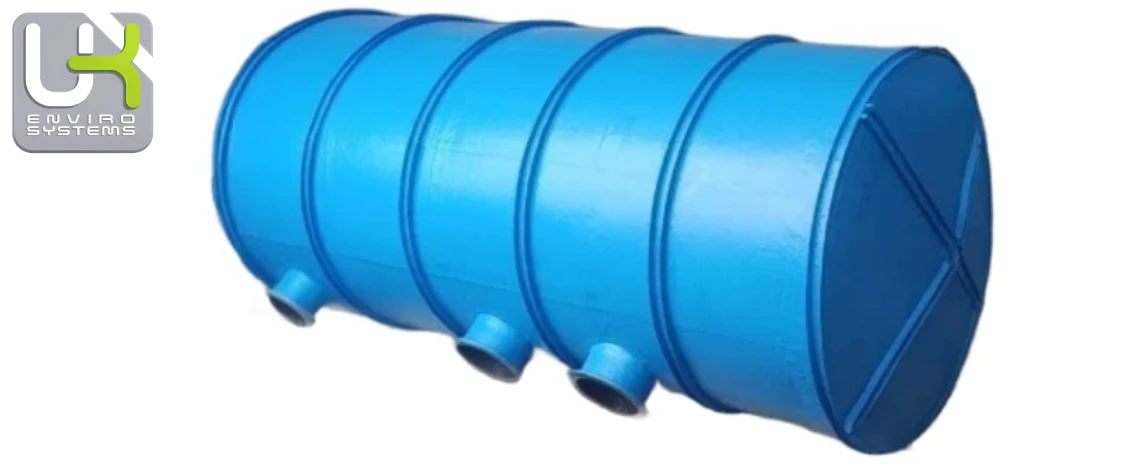
At UK Enviro Systems, we understand that a high-quality Treated Water Tank in STP infrastructure is essential. It serves as the reliable backbone for every modern sewage treatment plant. This tank must hold treated effluent safely without leaks or contamination. Engineers now prefer advanced composite materials over outdated metal or concrete designs. A well-built Treated Water Tank in STP ensures consistent supply for flushing, landscaping, and industrial processes.
It also preserves the chemical quality of recycled water. In this article, we explore why fiberglass reinforced plastic (FRP) units excel. You will discover technical benefits, installation insights, and long-term value. Your facility deserves a Treated Water Tank in STP that delivers performance decade after decade.
The Critical Role of Treated Water Storage in Modern STPs
A sewage treatment plant processes raw wastewater into reusable effluent. The final step involves storing this treated water safely. Therefore, the Treated Water Storage Tank acts as a buffer between treatment and end-use.
It must prevent contamination and resist internal corrosion. Moreover, it must endure fluctuating pressures without any failure. An inferior STP Water Storage Tank can undo the hard work of biological and chemical treatment. For example, rust particles from a metal tank can pollute the clean water. Consequently, the entire treatment chain fails its purpose.
A purpose-built Industrial Treated Water Tank solves these problems with advanced material science. It maintains water quality while withstanding harsh site conditions. Additionally, modern STP plants demand a Treated Water Storage Tank that integrates seamlessly with SCADA and pumping systems.
Why Material Selection Matters for Treated Water Storage
The material of your tank directly impacts life cycle costs. Mild steel tanks need frequent painting and still corrode. Concrete structures develop cracks and leak over time. A Corrosion Resistant Water Tank, however, eliminates these headaches entirely.
FRP materials resist a wide range of chemicals. These include chlorine and mild acids found in treated effluent. This chemical inertness keeps the Wastewater Treatment Tank free from internal scaling. The smooth inner surface of an FRP Storage Tank also reduces biofilm attachment. As a result, the stored water remains hygienic and odor-free. Plant operators appreciate how a Leak Proof Water Tank simplifies compliance with environmental norms.
FRP: A Game-Changer for Treated Water Storage
Fiberglass reinforced plastic combines high-strength glass fibers with durable thermosetting resin. This composite creates a Treated Water Tank in STP that is strong yet surprisingly lightweight. The laminate structure forms a monolithic shell with zero joints or welds. Consequently, there are no weak points where leaks typically start.
An FRP Treated Water Tank can withstand internal pressures and external wind loads easily. Furthermore, advanced resin formulations provide UV protection for outdoor installations. The smooth gel coat layer inside meets food-grade standards for water quality. An FRP Treated Water Tank thus becomes the ideal Recycled Water Tank for eco-conscious projects.
Superior Corrosion Resistance
Metal tanks react with dissolved salts and residual disinfectants. This reaction causes rust and metal leaching. An FRP Treated Water Tank remains completely inert. It handles pH variations from 3 to 11 without degradation.
High chloride levels in treated effluent cause pitting in stainless steel. Yet the Corrosion Resistant Water Tank made from FRP faces no such threat. The vinyl ester resin barrier creates an impervious shield. Consequently, the tank interior stays smooth and uncontaminated for decades. This performance makes the FRP Treated Water Tank the top choice for coastal STP installations.
Leak-Proof and Hygienic Design
Traditional concrete tanks often develop hairline cracks. Bolted steel tanks rely on gaskets that degrade. A Leak Proof Water Tank built with FRP eliminates all these failure modes. The manufacturing process creates a seamless, one-piece structure.
For larger volumes, sections bond chemically to form a unified body. Therefore, the Treated Water Tank in STP never suffers from gasket fatigue or sealant failure. The non-porous surface also prevents algae growth. This hygienic design is vital when the water gets reused for cooling tower makeup or irrigation.
Lightweight Yet Strong Structure
An FRP Storage Tank weighs a fraction of a concrete equivalent. This characteristic reduces foundation costs dramatically. A lightweight Treated Water Tank in STP allows rooftop installations on existing buildings. It also simplifies transportation to remote project sites.
Despite its low weight, the high tensile strength of glass fibers provides exceptional structural integrity. An Industrial Treated Water Tank made from FRP can withstand seismic loads better than rigid concrete. Moreover, the flexibility of FRP absorbs vibrations from nearby pumps.
Customization and Modularity
Every STP layout is unique. A Customized Treated Water Tank fits perfectly into restricted spaces. UK Enviro Systems manufactures vertical and horizontal configurations with various dome designs. You can specify nozzle orientations, manhole sizes, and ladder positions.
A Treated Water Tank in STP can also feature internal baffles for chlorine contact time. The modular approach allows capacity expansion later. Simply add new FRP sections to increase storage volume. This scalability gives plant designers tremendous freedom.
Technical Specifications of FRP Tanks for STP Applications
Understanding the technical build-up helps engineers specify correctly. A typical Treated Water Tank in STP uses a three-layer construction. The inner corrosion barrier has high resin content for maximum chemical resistance. The structural layer contains oriented glass fibers for hoop and axial strength.
The outer gel coat protects against UV and weather. Standards like BS EN 13121 and ASTM D3299 guide the design factors. Our FRP Treated Water Tank design incorporates a safety factor of at least 8:1 on ultimate tensile strength. This ensures long-term reliability under cyclic loading.
Lamination Process and Resin Selection
The lamination process determines the quality of the FRP Storage Tank. We use either filament winding or hand lay-up techniques based on size. Filament winding provides precise fiber orientation for hoop strength. Hand lay-up allows complex shapes and integrated fittings.
The choice of resin depends on the chemical profile of the effluent. A Wastewater Treatment Tank exposed to aggressive cleaning agents benefits from vinyl ester. For standard municipal STP water, isophthalic resin offers excellent value. The curing process happens under controlled conditions to achieve complete cross-linking. Thus, the Treated Water Tank in STP gains its full mechanical properties.
Structural Integrity and Load Considerations
An Industrial Treated Water Tank must handle hydrostatic pressure plus external loads. We design each unit for wind speeds as per local standards. Seismic calculations consider the sloshing effect of stored water. Therefore, the Treated Water Tank in STP includes stiffening ribs in high-stress zones.
Finite element analysis validates the design before fabrication. Moreover, the tank floor receives extra reinforcement to withstand constant hydraulic pressure. This engineering ensures that the Leak Proof Water Tank remains safe even under extreme conditions.
Comparing FRP with Traditional Materials
Concrete tanks are heavy and prone to cracking. Steel tanks need cathodic protection and costly maintenance. In contrast, an FRP Treated Water Tank requires minimal upkeep. It never needs repainting or internal lining replacement.
The smooth interior resists sludge build-up, reducing cleaning frequency. Furthermore, the thermal insulation of FRP is superior to steel. This property stabilizes the temperature of the Recycled Water Tank, preventing condensation on the outer surface. Over a 30-year life cycle, the Treated Water Storage Tank of FRP proves far more economical.
| Material | Corrosion Resistance | Weight | Maintenance | Life Span |
|---|---|---|---|---|
| FRP | Excellent | Low | Minimal | 30+ years |
| Steel | Poor (needs coating) | Heavy | High | 15-20 yrs |
| Concrete | Moderate | Very Heavy | Moderate | 20-25 yrs |
Installation and Maintenance Benefits
On-site assembly of a Treated Water Tank in STP is swift. FRP panels or filament-wound shells arrive ready for placement. A small crane easily lifts the lightweight sections. Consequently, project timelines shrink significantly. The tank requires no welding or heavy civil work.
Once installed, the STP Water Storage Tank asks for very little attention. A simple annual inspection of the exterior and manhole seals suffices. The anti-microbial gel coat inside keeps the Treated Water Storage Tank clean without harsh chemicals. As a result, operational downtime is virtually eliminated.
Environmental Impact and Sustainability
A Recycled Water Tank directly supports green building certifications. Using treated effluent reduces freshwater demand. The FRP material itself also offers environmental benefits. Its production consumes less energy than steel or concrete.
The corrosion-free nature means no protective paints that release VOCs. Furthermore, at the end of its long service, the FRP can be co-processed in cement kilns for energy recovery. An FRP Storage Tank thus contributes to a circular economy. Choosing a Treated Water Tank in STP from UK Enviro Systems reinforces your commitment to sustainability.
Why UK Enviro Systems is Your Ideal Partner
As a premier Treated Water Tank Manufacturer, we combine engineering excellence with customer-centric service. Our team designs each Customized Treated Water Tank to match exact site requirements. We act as a reliable FRP Treated Water Tank Supplier for projects across India and beyond.
Our factory follows rigorous quality protocols under ISO management systems. Being a trusted STP Water Tank Manufacturer in India, we understand local regulations and climatic challenges. Whether you need a small 5,000-litre tank or a massive 500,000-litre STP Water Storage Tank, we deliver on time. We support your project from initial design through commissioning. Invest in a Treated Water Tank in STP that brings you peace of mind.
Modern STP systems demand storage solutions that match their high-efficiency treatment. An FRP tank offers unbeatable corrosion resistance, leak-proof integrity, and design flexibility. It protects the quality of treated effluent and simplifies plant operations.
Therefore, the Treated Water Tank in STP should always be an engineered FRP unit. UK Enviro Systems stands ready to provide a tailored Industrial Treated Water Tank that fits your exact needs. Upgrade your infrastructure today and experience the difference of advanced composite technology.
Frequently Asked Questions
FRP is corrosion-resistant, lightweight, and leak-proof. It prevents rust and biofilm growth, ensuring pure water. Its seamless construction eliminates joint failure, unlike steel or concrete.
An FRP treated water tank lasts over 30 years. Its chemical-resistant laminate protects against effluent and UV rays, maintaining structural strength without repainting or relining.
Yes, it handles high chlorine levels easily. The vinyl ester resin barrier is fully oxidation-resistant. It keeps the tank interior smooth and free from degradation.
We supply customized tanks from 5,000 to 500,000 litres. You can specify nozzle locations, baffles, and manhole sizes to perfectly match your plant layout.
No, its lightweight design only needs a simple level concrete pad. This drastically reduces civil costs and installation time compared to heavy concrete or steel tanks.