
Replace Rusting Metal Tanks with Durable FRP Storage Tanks in Barmer
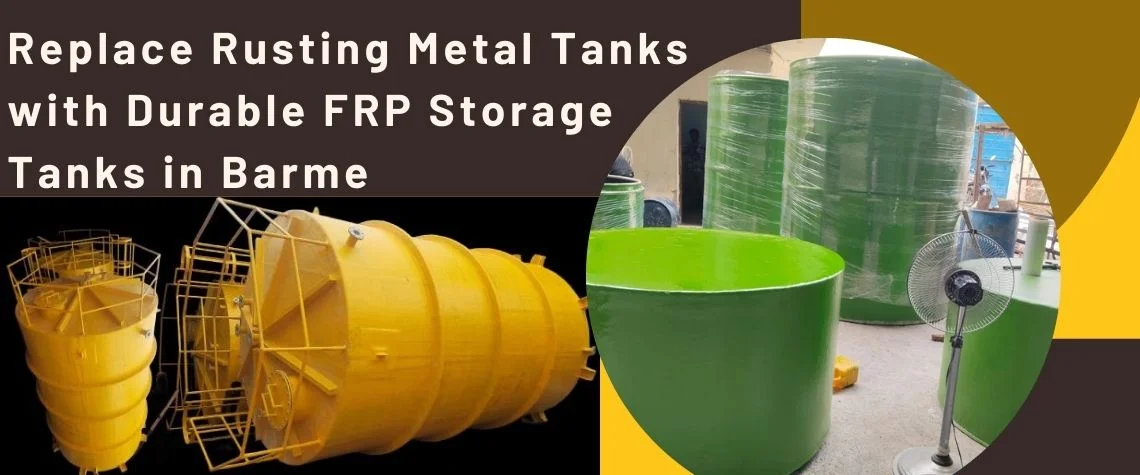
Is the scorching heat of Barmer slowly killing your metal storage tanks?
Barmer has rapidly emerged as a powerhouse for chemical processing, water treatment, and mineral-based industries, but the persistent challenge of rust and corrosion in traditional metal storage tanks continues to drain operational budgets. As a trusted FRP Tank Manufacturers in Barmer, we’ve seen firsthand how steel and concrete tanks degrade within months when exposed to aggressive chemicals, saline water, or even Barmer’s extreme desert climate.
That’s why industries across the region are now switching to Fiber Reinforced Plastic (FRP) storage tanks—a zero-rust, virtually maintenance-free alternative that outlasts metal by decades. Whether you’re running an ETP plant, a chemical unit, or an acid handling facility, FRP technology delivers safety, longevity, and significant cost savings without the headache of constant repairs.
Why Replace Rusting Metal Tanks with FRP Storage Tanks in Barmer?
- Superior Corrosion Resistance: Unlike metal tanks that rust when exposed to chemicals, moisture, and saline environments, FRP Storage Tanks in Barmerare inherently corrosion-resistant. They are ideal for storing:
- Acids (HCL, Sulfuric Acid)
- Alkalis
- Saline solutions
- Industrial wastewater
- Chemicals used in pickling and electroplating
- Lightweight Yet Extremely Durable: FRP tanks are significantly lighter than steel or concrete tanks, making them easier to transport and install. Despite their lightweight nature, they offer exceptional strength and can last 20-30 yearswith minimal maintenance.
- Customizable for Various Industrial Needs: As a trusted FRP Tanks Manufacturers, we offer customized solutions for:
- Chemical Storage Tanks in Barmer – Safe storage for aggressive chemicals
- ETP & STP Tanks in Barmer – Ideal for effluent and sewage treatment plants
- Acid Storage Tanks in Barmer – Perfect for HCL, sulfuric acid, and other corrosive liquids
- PP FRP Tanks in Barmer – Combines polypropylene lining with FRP for enhanced chemical resistance
- Low Maintenance & Long-Term Cost Savings: Metal tanks require frequent repainting, welding repairs, and replacements due to rust. FRP tanks, on the other hand, are virtually maintenance-free, reducing downtime and operational costs.
- Temperature & Weather Resistance: Barmer’s extreme climate can accelerate metal tank degradation. FRP Storage Tanks in Barmerwithstand high temperatures, UV exposure, and harsh weather without cracking or corroding.
Industries in Barmer That Benefit from FRP Tanks
Barmer’s industrial sector is diverse, with several key industries relying on storage tanks for smooth operations:
- Chemical & Petrochemical Plants: Chemical industries in Barmer handle aggressive substances that demand corrosion-resistant Chemical Storage Tanks in Barmer. FRP tanks ensure safe storage without contamination risks.
- Water & Wastewater Treatment Facilities: Municipal and industrial ETP Tanks in Barmerand STP Tanks in Barmerrequire durable, leak-proof storage solutions to manage effluents effectively.
- Mining & Mineral Processing: Mining operations involve acidic and abrasive slurries. FRP Acid Storage Tanks provide a reliable solution for handling such corrosive materials.
- Textile & Dye Industries: Textile units use various dyes and chemicals that can degrade metal tanks. PP FRP Tanks in Barmeroffer superior resistance to dyes and solvents.
- Oil & Gas Sector: Storage of brine solutions, drilling chemicals, and wastewater requires non-corrosive FRP tanksto prevent leaks and environmental hazards.
Why Choose Us as Your Trusted FRP Tanks Manufacturer in Barmer?
We are a leading FRP Storage Tank Manufacturer in Barmer, specializing in high-performance storage solutions. Here’s why industries trust us:
- High-Quality Raw Materials– We use premium-grade resins and fibers for unmatched durability.
- Custom Engineering– Tanks are designed to meet specific chemical, pressure, and temperature requirements.
- Leak-Proof & Hygienic– Smooth inner surface prevents bacterial growth and contamination.
- Compliance with Industry Standards– Our tanks meet IS, DIN, and ASTM standards for safety and performance.
- Quick Delivery & Installation– We ensure timely supply and hassle-free installation across Barmer.
Upgrade to FRP Tanks Today!
If you’re still using outdated metal tanks, it’s time to switch to FRP Storage Tanks in Barmer for a rust-free, low-maintenance, and long-lasting storage solution. Whether you need Chemical Tanks in Barmer, HCL Storage Tanks in Barmer, or Pickling Tanks in Barmer, we have the perfect FRP solution for you.
Contact the leading FRP Tanks Manufacturer in Barmer today for a free consultation!
Frequently Asked Questions
No. Cheap polyethylene or PVC tanks soften and creep at 50–60°C. FRP tanks use heat-stable isophthalic or vinyl ester resins reinforced with glass fibers. They are engineered to handle continuous temperatures up to 100–120°C (depending on resin grade) without deformation. In Barmer’s 48°C peak summer, an FRP tank remains structurally stable and retains full chemical resistance.
Yes – if specified correctly. Standard epoxy or polyester FRP may not. But our “multi-chemical” FRP liners (e.g., vinyl ester or dual laminate PP-FRP) resist both strong acids (HCl, H₂SO₄) and alkalis (NaOH, caustic). Always share your full chemical swing data with us; we’ll recommend a resin system that won’t degrade from pH cycling.
Partially true – for poorly manufactured FRP. Osmotic blistering happens when low-quality resin or improper fiber wet-out allows moisture vapor to penetrate. We prevent this by using barrier coats, high-grade vinyl ester resin, and post-curing. Our tanks are built for open-air installation in Barmer’s humid conditions (post-monsoon). Ask for our osmotic blister warranty.
Yes – and this is a major advantage over metal or concrete. FRP tanks can be sectionally manufactured and joined on-site using overlapping laminates or flanged connections. No heavy welding equipment. No 50-ton crane. For very large diameters (above 3m), we can fabricate in halves or panels and assemble inside your existing shed.
Ask for immersion test data per ASTM C581. We provide certified chemical resistance tables showing weight change, flexural strength retention, and hardness after 6+ months of exposure to your specific acid concentration. For H₂SO₄ >80%, we recommend a proprietary resin + liner system. If a manufacturer can’t show long-term data, don’t buy.
Standard FRP has moderate abrasion resistance. But we add an abrasion-resistant veil (ceramic-filled or AR glass layer) on the inner surface. For high-solids streams, we also offer replaceable wear strips. In most Barmer chemical ETPs, properly designed FRP outlasts stainless steel because it doesn’t pit or corrode at wear points – just specify the solids load upfront.
Yes – ask for flame-retardant FRP (FR grade). We add halogenated resins or alumina trihydrate fillers to achieve self-extinguishing properties (ASTM E84 Class 1). While FRP is not completely non-combustible, fire-retardant grades significantly slow flame spread. For extremely flammable solvents, we recommend secondary containment or external fireproofing – we’ll advise based on your NFPA class.
Absolutely – if the inner surface is built with high-crosslink density vinyl ester and minimum 3–4 mm corrosion liner. Avoid cheap orthophthalic resin for abrasive cleaning. Many of our clients in Barmer use rubber scrapers or plastic shovels inside FRP tanks without damage. Just never use metal tools or sharp edges.
Typical FRP lifespan in Barmer’s chemical environment:
For aggressive acids/alkalis (with correct resin): 15–20 years minimum.
For water / ETP service: 25–30 years.
Many of our tanks installed in 2005 are still in service with only cosmetic fading. The cost per year of FRP is often 60–70% lower than metal when factoring in downtime, painting, and leak repairs.
Yes. We can provide test coupons (150x150 mm) of the exact laminate sequence and resin system proposed for your tank. Soak them in your actual process chemical for 30 days at your plant’s max operating temperature. Measure weight change and hardness. Only then do we proceed with full fabrication – no guesswork. That’s our confidence.